

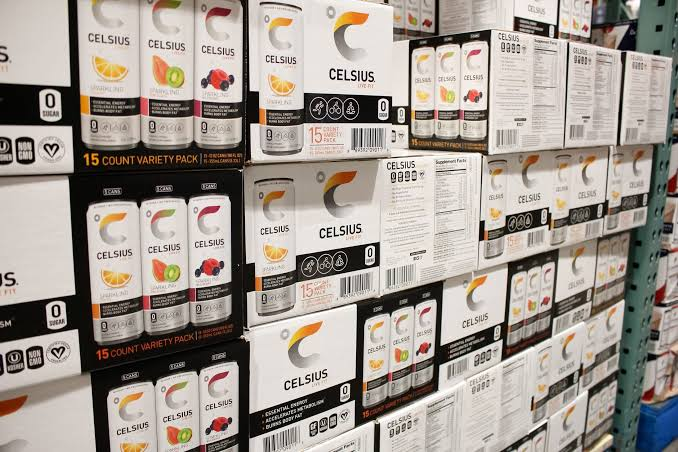
Celsius Holdings (CELH) has been a rough name to own. At $27.86, the stock sits about 71% below its March 2024 high, and I get why a lot of investors are starting to call a bottom here.
I’m not one of them. I rate Celsius a “Sell,” and the reason isn’t the headline numbers. It’s two sets of numbers that should line up and don’t.
In Q2, the CELSIUS brand’s retail sales in tracked channels slipped 2% y/y. Its reported net revenue, meanwhile, fell 11.7%. Alani Nu showed the same gap from the other side, with retail sales up 55.7% but net revenue up only 21%, per the Q2 earnings release.
Well, a gap like that can happen in any one quarter. But when it shows up in both brands at once and points the same way, I start asking where the money went. My answer is promotions. Celsius is selling more cans than ever, but it’s paying more to move each one, and today’s price still assumes that cost comes back down in 2027. I think part of it won’t, and that’s how I get to a fair value of about $24.
I last covered Celsius in September with a “Hold” rating, when the stock traded at $27.64. The price has barely moved since then, so I owe readers an explanation for why my rating has. Part of it is new information, which I’ll get to shortly. The other part is my own model. Back then, I put an 18x multiple on $1.55 of 2027 EPS and assumed about $3.40 billion of revenue, which got me to roughly $28. Looking harder at the same Q2 numbers, I no longer think the gap between shelf sales and reported revenue closes on its own, and I hadn’t accounted for the slice of earnings that goes to PepsiCo’s preferred stock. My EPS still lands at $1.55, but it now rests on much slower growth, and I don’t think that’s worth 18x.
Celsius Is Now Three Brands Sold Through One Partner
If you’re not familiar with the name, Celsius is a functional beverage company, and it isn’t a one-brand story anymore. It now owns three energy brands: CELSIUS, Alani Nu, which it bought in April 2025, and Rockstar in the U.S. and Canada, which it bought from PepsiCo (PEP) in August 2025, according to the Q2 10-Q. Put together, those brands held about 20.1% dollar share of U.S. energy drinks in Circana’s tracked channels. That’s just scanner data from grocery, convenience and mass retailers.
Now, here’s the part I think matters most. PepsiCo is on both sides of this business. It distributes all three brands in the U.S. and Canada, it holds $1.135 billion of Celsius’ convertible preferred stock, and it has two seats on the board. Plus, about 60% of Q2 revenue, or $492.3 million, came from this related party.
That matters, because it shapes how much of each retail dollar Celsius actually gets to keep. I’ll come back to that after a quick look at what’s changed since my last article.
What’s Changed Since My September Hold Call
Three things have moved against the bull case, and I don’t think the market has fully dealt with any of them.
First, the core brand got worse, not better. At the Barclays consumer conference on September 8, CEO John Fieldly said CELSIUS scan data on IRI had been running down anywhere between 5% and 10%, per the conference transcript. That’s a clear step down from the 2% decline in Q2. He also said plainly that CELSIUS will be down this year, with the hope of getting it back to growth as 2026 ends.
Second, the margin path got longer. At the same event, CFO Jarrod Langhans said fuel prices had spiked a bit in August and September, and that if aluminum and fuel stay where they are, the return to low-50s gross margins will take longer.
Third, the legal overhang now points at Alani Nu, the brand doing the heavy lifting. A securities class action filed in the Southern District of Florida (case 26-cv-62465) covers purchases from February 21, 2025 to June 3, 2026, and alleges that Alani Nu products didn’t adequately disclose cardiac risks and were marketed to people under 18, per Rosen Law Firm’s notice. The 10-Q also discloses a June 2026 civil investigative demand from the Texas Attorney General and a wrongful-death suit tied to Alani Nu, where Celsius is obligated to indemnify the distributors named as defendants. None of these has a dollar figure attached yet. But they all land on the one brand that’s carrying the growth.
To be fair, a couple of things have gone the right way too, and I’ll cover them in the risks section.
Also Read –
- Vince Holding: The Core Business Is Improving, But the Turnaround Still Needs to Prove Itself
- AES Corporation: The $15 Offer Makes A Buy Rating Difficult
- Ituran: A 20% Earnings Compounder Trading At A Mid-Teens Multiple
- CDW: The Best Economics In IT Distribution, But The Cash Flow Keeps Me At Hold
Celsius’ Shelf Sales Are Growing Faster Than Its Revenue
Reported revenue grew 10.6% y/y to $817.9 million in Q2, which looks fine at first glance. But Rockstar wasn’t in last year’s Q2, so that number flatters things. The 10-Q also gives a pro forma view, which treats both deals as if they had closed on January 1, 2024, and on that basis revenue grew just 1.7%. Pro forma net income attributable to common stockholders fell from $94.6 million to $36.4 million.
So that’s the real growth rate today. Here’s how it breaks down by brand.
| Brand | Q2 2026 net revenue | Q2 2025 | Change | Q2 retail sales, tracked channels |
|---|---|---|---|---|
| CELSIUS | $387.0M | $438.1M | -11.7% | -2% |
| Alani Nu | $364.4M | $301.2M | +21.0% | +55.7% |
| Rockstar | $66.5M | n/a (acquired Aug. 2025) | n/a | -13% |
Now, management did give a fair explanation for part of the CELSIUS gap. On the Q2 earnings call, Langhans said distributor inventory drawdowns accounted for roughly half of it. In other words, distributors were working down cases they already had, and that half should reverse. The rest came from heavier trade and promotional spend and softer club-channel shipments, and the promotional piece is the part I care about.
Alani Nu makes the point even more clearly. Langhans said its gross revenue grew about 39%, but net revenue grew about 21%, with promotional allowances and channel mix in the DSD system making up the difference. DSD, or direct store delivery, just means the distributor’s own trucks and staff stock the shelves, and it comes with heavier trade costs per case. Now, management does expect part of Alani’s gap to ease from Q1 2027 as some discontinued non-ready-to-drink products roll off, and I’ll give them that. But at Barclays, Langhans also said Alani’s DSD mix has settled at about 60%, and that a non-cash captaincy asset will keep being amortized against revenue for the next 16 to 17 years. Those two pieces aren’t going away, so I don’t see the full gap closing.
The balance sheet tells me the same thing. Accrued promotional allowances, which are promotions Celsius has booked but not yet paid, rose 47% in six months to $453.0 million. And $247.6 million of that is owed to PepsiCo, per the earnings release. Gross margin also fell to 48.1% from 51.5%, mainly on higher promotional activity and channel mix.
What about the rest of the year? On the Q2 call, management said CELSIUS should look like Q2 again in Q3 before returning to growth, with new cooler space and the 16-ounce launch helping in 2027. Fieldly was pretty candid about how the brand got here, admitting the company “went too deep on the Celsius rationalization,” meaning it cut too many products (SKUs, or individual flavor and size combinations) before the new shelf space showed up. I respect that. But Langhans also expects Q3 gross margin in the high 40s, since diesel and aluminum costs are largely offsetting the planned savings.
That’s why my 2027 model is a modest one. I’m assuming CELSIUS net revenue falls another 4%, Alani Nu grows 10% and Rockstar declines 10%. With CELSIUS scans running down 5% to 10% heading into year-end, I don’t think another 4% decline is a harsh assumption, even with new products on the way. That takes revenue from my 2026 estimate of $3.13 billion to about $3.20 billion, or roughly 2% growth. Seeking Alpha’s consensus sits at $3.44 billion. I believe the Street is counting on that gross-to-net wedge to narrow. I’m not.
Cash Flow Looks Better Than It Is
First-half operating cash flow came in at $296.3 million against just $25.0 million of capex. That’s a healthy-looking number, but $145.1 million of it came from those promotions that were booked and not yet paid. At some point, that bill comes due.
On the balance sheet, cash of $631.2 million roughly offsets $667.9 million of debt. Celsius has also accrued $85.0 million for the Strong Arm Productions royalty case, where it’s appealing a $101.1 million judgment. And one more detail stood out to me: first-half buybacks averaged $31.38 a share, which is above where the stock trades today.
That brings us to the price.
Valuation: The Recovery Is Already Priced In
I value Celsius on what I think it can earn per share in 2027, using a P/E multiple based on its peers. Let’s walk through it.
I start with $3.20 billion of revenue and a 23% adjusted EBITDA margin. That’s slightly below the first half’s 23.7%, since Q2 already slipped to 22.5%. So that gets me to about $736 million. From there, I take out roughly $40 million of depreciation and $36 million of stock comp (about double the first-half pace), around $30 million of net interest and 21% tax. That leaves around $498 million of net income.
Then there’s PepsiCo’s preferred stock, which quick screens often skip. It pays 5% a year on $1.135 billion, or about $57 million. On top of that, about 11.5% of whatever’s left is allocated to the preferred under the two-class method, an accounting rule that splits earnings between common and participating preferred holders. That matches what happened in Q2. After all that, I’m left with roughly $391 million for common shareholders, or $1.55 per share on 252 million diluted shares. Consensus, for comparison, is $1.62.
For the multiple, I’m using 15x. PepsiCo trades at about 14.4x forward earnings, Keurig Dr Pepper (KDP) at 12.3x and Coca-Cola (KO) at 25x. To me, Alani Nu’s growth earns Celsius a small premium over PepsiCo, but no more than that, given 1.7% pro forma growth and 60% of revenue running through one customer. That puts my base value at $23.25.
Here’s how the three cases stack up:
| Scenario (weight) | 2027 assumptions | EPS | P/E | Value per share | vs. $27.86 |
|---|---|---|---|---|---|
| Bull (25%) | CELSIUS +3%, Alani Nu +14%, Rockstar -5%, 25% EBITDA margin | $1.84 | 18x | $33.12 | +19% |
| Base (50%) | CELSIUS -4%, Alani Nu +10%, Rockstar -10%, 23% margin | $1.55 | 15x | $23.25 | -17% |
| Bear (25%) | CELSIUS -10%, Alani Nu +5%, Rockstar -15%, 21% margin | $1.27 | 13x | $16.51 | -41% |
| Weighted | $24.03 | -14% |
The number that sticks with me is this one. Even if the Street’s $1.62 turns out to be right, 15x only gets you to $24.30. The stock already trades at 17.2x that consensus figure, so it needs both a recovery and a higher multiple to work from here. Personally, I’d rather not pay for both of those up front.
What Could Prove Me Wrong
The biggest risk to a Sell call here is PepsiCo itself. It already distributes the brands, owns the preferred and sits on the board. The preferred terms in the 10-Q also include a change-in-control redemption clause. So if a takeover bid ever came, this call would be wrong overnight. I’ve seen no sign of one, but investors should know the door is there.
Second, the shelf gains could show up faster than I expect. Management said delayed space at a large retailer came through in July, more is due in Q4, and the Q4 comparison is easier. If CELSIUS net revenue starts tracking within a few points of its scanner sales, my bull case comes into play.
Third, and honestly the strongest argument against me, is cash flow. On my base case, free cash flow to common holders after preferred dividends is roughly $460 million. That’s about a 6.5% yield. To me, that’s a fair yield for a low-growth business, but it’s not a bargain.
Buybacks could also put a floor under the stock. Celsius had $135.9 million left on its authorization at the end of June, per the 10-Q, and Langhans said on the Q2 call that the company intends to use the full $300 million this year. That’s real support at these prices, even if it doesn’t change what the business earns.
Insiders are buying, too. Fieldly bought about $494,000 of stock in September, and director Damon DeSantis bought around $1 million, per their Form 4 filings. I’ll take that as a real vote of confidence. It just doesn’t change my math.
On the other side, the Alani Nu legal matters I covered earlier and a second Strong Arm royalty suit could add costs I haven’t modeled.
Want to see whether this stock is still a buy at current levels? Run the full analysis to check fair value estimates, insider activity, technical signals, options positioning, support and resistance zones, and what analysts are expecting next in seconds.
What’s My Take?
I don’t doubt that Celsius owns strong brands, and Alani Nu is one of the fastest growers in U.S. energy. My problem is how much of that retail strength actually reaches shareholders. Right now, a lot of it is being paid away in trade spend, and I think much of that is simply the lasting cost of selling through PepsiCo’s DSD system.
At $27.86, the stock trades at about 18x my 2027 EPS estimate, and it still needs a recovery plus a higher multiple to work. My weighted fair value is $24.03, about 14% below today’s price. On top of that, the bear case carries more downside than the bull case offers upside. So I rate Celsius a “Sell,” which is a downgrade from my Hold in September.
The next test is Q3 earnings, which Seeking Alpha lists for November 6. Management has already told us CELSIUS will look a lot like Q2, gross margin should stay in the high 40s, and Alani Nu faces a tougher Q4 comparison against last year’s pipeline fill. So I don’t see an obvious near-term catalyst that rescues the stock. The real tests come in the first half of 2027, with shelf resets, the new 16-ounce Energy+ Hydration line announced on October 5, and management’s expected narrowing of the Alani gap. I’d move to a Hold if CELSIUS net revenue tracks within a few points of retail sales, if the promotional accrual stops climbing, or if gross margin heads back toward 50%. Until one of those happens, I’d steer clear.
Discussion & Perspectives
Join the conversation and share your valuation thesis or technical insights.
Sign in to join the discussion
Only verified Tickzen members can publish comments and share research perspectives.
No comments yet. Start the conversation by sharing your thesis above.